New Zealand Simulation
This page describes a numerical simulation of gravity waves over New Zealand's
south island. Primary orographic waves break at an altitude of about 80 km,
thereby generating secondary waves. The secondary waves are filtered by
viscous effects, but the longer wavelengths propagate to altitudes in excess
of 400 km.
Computational Domain
The layout of the of the simulation is shown in the figure below. The origin is located at
Mount Cook (43.5950° S, 170.1418° E).
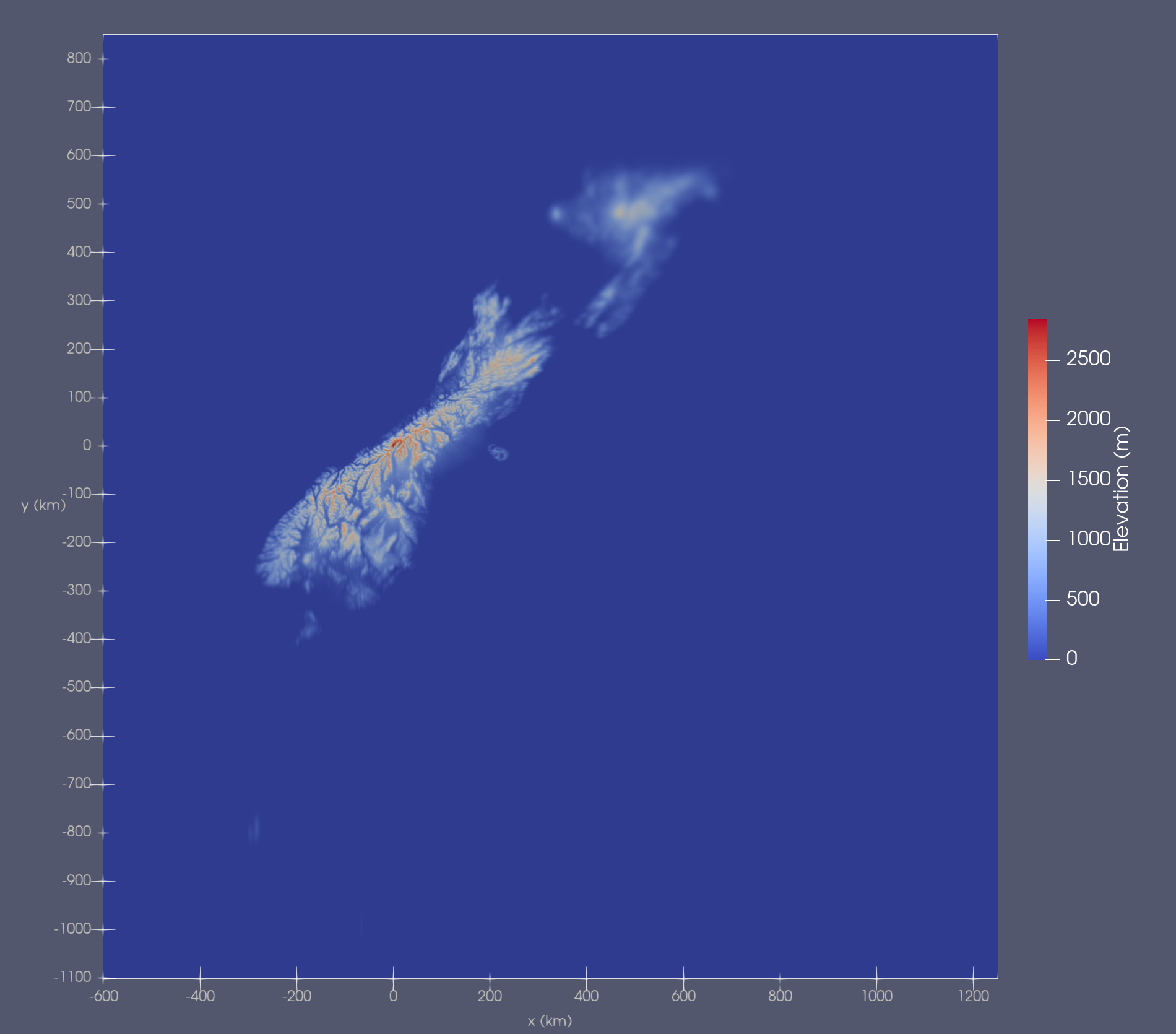
The computation grid uses horizontal mesh spacings of 1000 m in a region slightly
larger than the south island land mass. The mesh is then stretched gently to
the lateral boundaries. The vertical grid uses uniform spacing of 500 m up to
an altitude of 140 km. Beyond 140 km the mesh is subdivided into four
additional zones where the vertical grid is continuously stretched, but the
horizontal spacings jump by a factor of two across each interface. The
interfaces are located at 140, 200, 260 km, and the horizontal mesh
spacing increases from 500 m in the lowest zone to 1, 2, and 4 km in the
progressively higher zones. The vertical mesh spacing increases continuously
from an altitude of 140 km to the domain top at 400 km.
Inviscid wall boundary conditions are used and
the surface whereas characteristic (radiative) conditions are used at the
lateral and top boundaries.
Wind Profiles
The background winds vary according to ERA5/JAWARA/HWM/MSIS2.0 on June 21, 2014 starting
at 08:00 UTC. The data sources are merged together with weighted averages centered at
30 km and 120 km with widths of 6 km and 10 km respectively.
Forcing
In order to minimize starting transients, the mean winds are damped to zero
between the surface and 22 km. Forcing terms are then used to increase the
near-surface winds to the ERA5-provided values over a period of two
hours. The forcing terms follow a hyperbolic tangent function in time, which
results in very gentle accelerations near the beginning and end of the forcing
period. The maximum forcing rate is equivalent to that of a linear ramp
with a duration of thirty minutes.
The following animations provide an overview of the wave motion as imaged in meridional-altitude (xz) planes.
Wind Profiles
The background winds vary according to ERA5/JAWARA/HWM/MSIS2.0 on June 21, 2014 starting
at 08:00 UTC. The data sources are merged together with weighted averages centered at
30 km and 120 km with widths of 6 km and 10 km respectively.
Forcing
In order to minimize starting transients, the mean winds are damped to zero
between the surface and 22 km. Forcing terms are then used to increase the
near-surface winds to the ERA5-provided values over a period of two
hours. The forcing terms follow a hyperbolic tangent function in time, which
results in very gentle accelerations near the beginning and end of the forcing
period. The maximum forcing rate is equivalent to that of a linear ramp
with a duration of thirty minutes.Animation in xz planes
The following animations provide an overview of the wave motion as imaged in meridional-altitude (xz) planes.